Geuest

Nature · Earth Science

Minerals & Gemstones

The crystalline building blocks of the Earth

Back to Nature

Minerals are the naturally occurring, crystalline building blocks from which all rocks are made — each with a definite chemical composition and an orderly atomic structure. From common quartz to dazzling diamonds, they store the story of how and where they grew, and the rarest and most beautiful become treasured gemstones.

Known minerals
Over 5,900
Hardest
Diamond (Mohs 10)
Softest
Talc (Mohs 1)
Most common
Feldspar group

How They Form

Minerals crystallise wherever atoms lock into ordered structures: from cooling magma, from water evaporating or cooling in cracks, or from heat and pressure reshaping existing rock. Slow, undisturbed growth yields large, well-formed crystals; the exact conditions decide a mineral’s colour, hardness and form.

How Crystals Grow

Crystals grow into a cavity (geode)Mineral vein in fractureHost rock

Mineral-rich fluids fill a cavity and crystals grow inward over time, forming a geode lined with glittering points.

Types & Details

A cluster of clear quartz crystals
1

Silicate Minerals

The most abundant family on Earth

Form in nearly all rock-making settings
  • Built on silicon–oxygen frameworks
  • Make up most of the crust
  • Include quartz, feldspar and mica
  • Enormous range of colours and forms

Silicates dominate the Earth’s crust, built from silicon and oxygen tetrahedra linked in chains, sheets and frameworks. Quartz and feldspar alone make up most of the rock beneath our feet.

Example:Quartz crystal
A brilliant cut diamond gemstone sparkling
2

Precious Gemstones

Rare, hard and dazzling

Often formed deep and very slowly
  • Prized for beauty, rarity and hardness
  • Include diamond, ruby, sapphire, emerald
  • Cut and polished to reveal fire
  • Formed under special conditions

A handful of minerals are rare, hard and beautiful enough to be treasured as precious gems. Diamonds form deep in the mantle; rubies and sapphires are gem-quality corundum coloured by trace elements.

Example:Diamond
A metallic ore mineral specimen with a shiny surface
3

Ore Minerals

The metals that built civilisation

Concentrated by fluids and heat
  • Contain extractable metals
  • Include hematite, galena, bornite
  • Often metallic lustre
  • Concentrated in veins and deposits

Ore minerals hold metals in concentrations worth mining — iron from hematite, lead from galena, copper from sulphides. Hot fluids often concentrate them into rich veins.

Example:Hematite (iron ore)
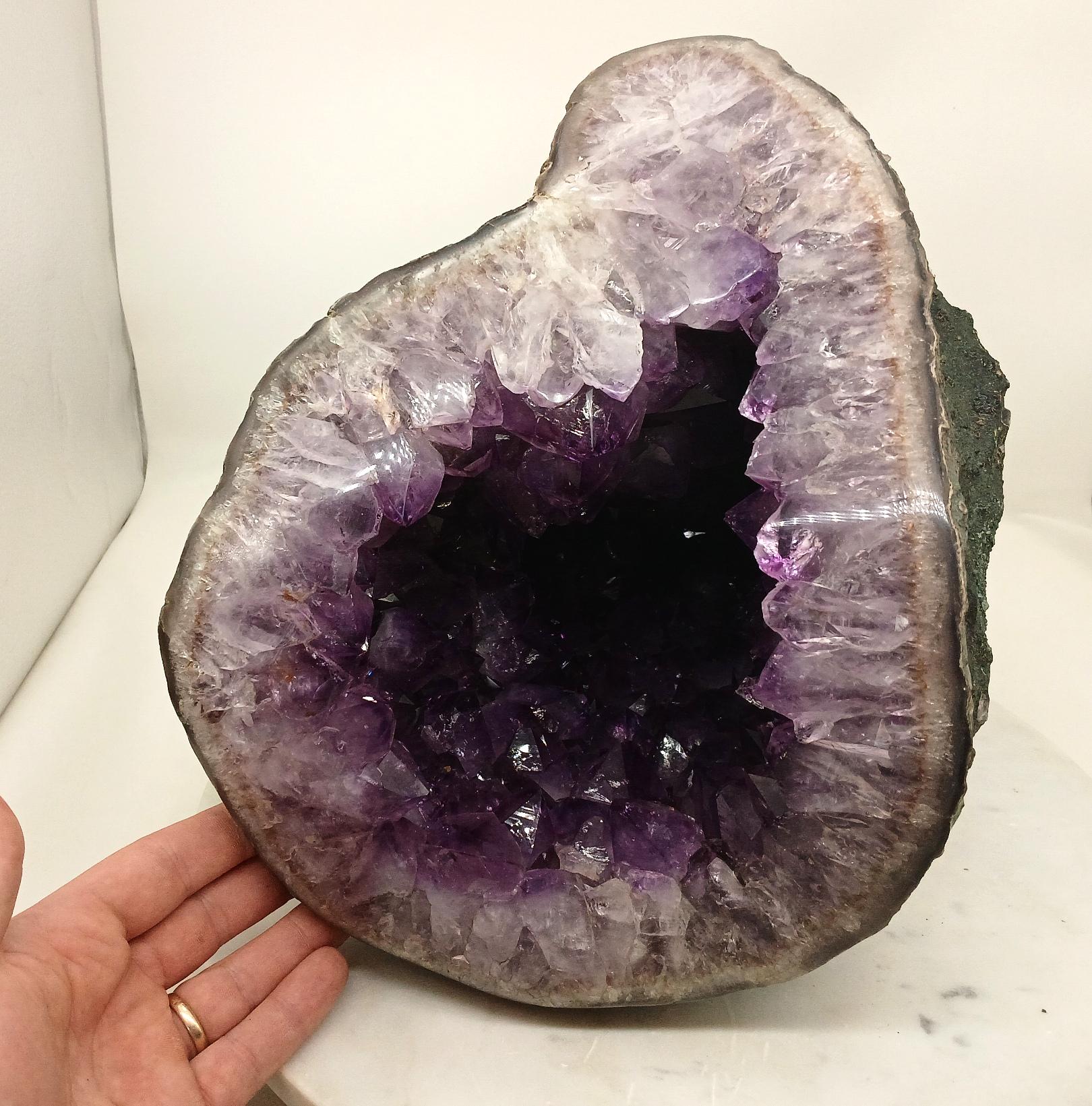
A geode split open to reveal purple amethyst crystals inside
4

Geodes & Druses

Hidden crystal-lined hollows

Grow over long, quiet spans
  • Hollow rocks lined with crystals
  • Plain outside, dazzling within
  • Grown from mineral-rich water
  • Often amethyst or quartz inside

A geode is an unremarkable-looking nodule that hides a cavity lined with inward-growing crystals. Mineral-rich water slowly deposits layer after glittering layer, sometimes as purple amethyst.

Example:Amethyst geode