Geuest

Nature · Earth Science

Earthquakes & Tectonics

The restless movements of the crust

Back to Nature

An earthquake is a sudden shaking of the ground caused by the abrupt release of energy in Earth's crust. They are the surface expression of plate tectonics — the slow drift of the rigid plates that make up Earth's outer shell, whose grinding edges build mountains and unleash quakes.

Largest recorded
Chile 1960 (M9.5)
Plates
~15 major & minor
Most active zone
Pacific 'Ring of Fire'
Measured by
Moment magnitude scale

How They Form

Earth's crust is broken into plates that move a few centimetres a year. Where they meet, stress builds until the rock suddenly slips along a fault, releasing energy as seismic waves. The point of slip is the focus; the spot directly above it on the surface is the epicentre.

Anatomy Of An Earthquake

Epicentre (surface)Focus (energy released)Fault planeOffset rock layers

Stress builds along a fault until rock slips at the focus; seismic waves radiate out and shake hardest at the epicentre above.

Types & Details

Mountains raised where tectonic plates collide
1

Convergent Boundaries

Where plates collide

Active over millions of years
  • Plates push together
  • Build mountains and trenches
  • Cause the most powerful quakes
  • Drive volcanic arcs

When plates collide, one may dive beneath the other or they may crumple upward. These zones raise great mountain ranges and produce Earth's mightiest earthquakes.

Example:The Himalayas & Andes
Rift valley where tectonic plates pull apart
2

Divergent Boundaries

Where plates pull apart

Continuously creating new crust
  • Plates move apart
  • New crust wells up between them
  • Form mid-ocean ridges and rifts
  • Usually gentler quakes

As plates separate, magma rises to fill the gap and create fresh crust, building undersea ridges and tearing open continental rift valleys.

Example:Mid-Atlantic Ridge
Long fault line where plates slide past each other
3

Transform Boundaries

Where plates grind past each other

Active over geological time
  • Plates slide sideways
  • Crust is neither made nor destroyed
  • Produce sudden shallow quakes
  • Trace long visible faults

Here plates scrape horizontally past one another. They lock, build stress, then slip abruptly — the cause of the famous quakes along faults like the San Andreas.

Example:San Andreas Fault, USA
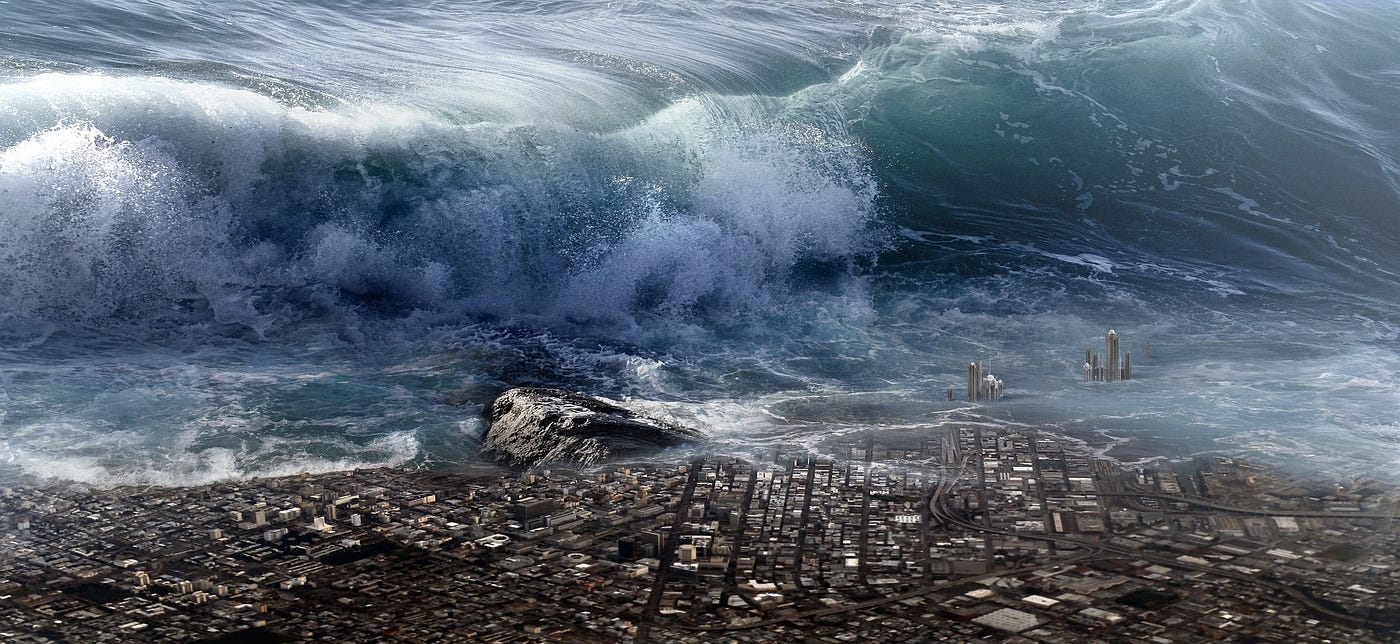
Large tsunami wave approaching a coastline
4

Tsunamis

Ocean waves born of the seabed

Triggered in moments, felt for hours
  • Set off by undersea quakes
  • Barely noticed in deep water
  • Rear up huge near the coast
  • Travel at jet-plane speeds

When the seabed jolts upward in a quake, it shoves the whole water column, sending fast, low waves across the ocean that pile into towering walls at the shore.

Example:Indian Ocean tsunami, 2004