Geuest

Nature · Earth Science

Layers Of The Earth

A journey to the centre of the planet

Back to Nature

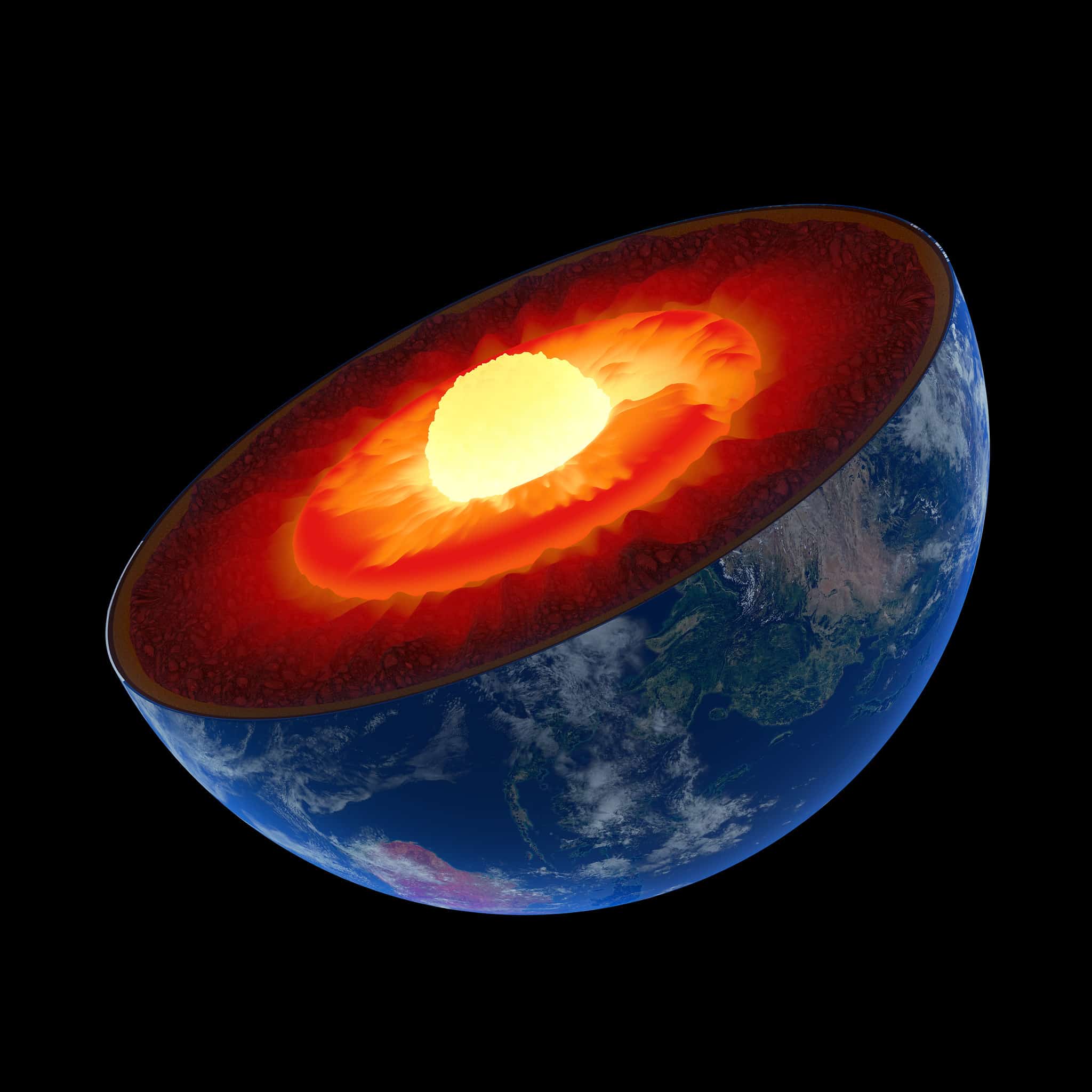
Our planet is layered like an onion, from the thin rocky crust we live on down to a scorching iron core hotter than the surface of the Sun. Each layer — crust, mantle, outer core and inner core — has its own composition, temperature and behaviour, and together they drive everything from earthquakes to Earth’s magnetic field.

Radius
~6,371 km
Crust depth
5–70 km
Core temperature
~5,200 °C
Layers
Crust, mantle, core

How They Form

As the young Earth melted, its materials separated by density: heavy iron and nickel sank to form the core, while lighter rock floated up to form the mantle and crust. This layering, set over four billion years ago, still shapes the dynamic planet we know today.

Inside Planet Earth

Crust — thin & rockyMantle — hot flowing rockOuter core — liquid ironInner core — solid iron

From the thin crust through the vast mantle to the molten outer core and solid inner core at the centre.

Types & Details

A cutaway showing Earth’s thin rocky crust
1

The Crust

The thin skin we live on

Continents up to ~4 billion years old
  • Thinnest, outermost layer
  • Oceanic crust thin and dense
  • Continental crust thick and light
  • Broken into tectonic plates

The crust is a wafer-thin rocky shell — just a few kilometres thick under oceans, tens under continents. It is all we ever see and touch, yet a tiny fraction of the planet.

Example:Continental & oceanic crust
A cutaway showing Earth’s glowing thick mantle layer
2

The Mantle

The slow-flowing bulk of Earth

As old as the planet
  • The thickest layer by far
  • Hot, solid rock that flows slowly
  • Convection currents drive plates
  • Source of most magma

The mantle makes up most of Earth’s volume — hot rock that flows like thick tar over ages. Its churning convection currents are the engine that drags the plates across the surface.

Example:Convecting rock, ~2,900 km thick
A cutaway showing Earth’s glowing molten outer core
3

The Outer Core

A sea of molten metal

Formed with the planet
  • Liquid iron and nickel
  • Swirls as Earth rotates
  • Generates the magnetic field
  • Extremely hot and dense

The outer core is a vast ocean of molten iron and nickel. Its swirling motion acts as a giant dynamo, generating the magnetic field that shields Earth from harmful solar radiation.

Example:Earth’s magnetic dynamo
A cutaway showing Earth’s bright solid inner core
4

The Inner Core

A solid iron heart

Slowly growing over billions of years
  • Solid iron–nickel sphere
  • Hotter than the Sun’s surface
  • Kept solid by immense pressure
  • Slowly crystallising and growing

At the centre lies a solid ball of iron and nickel, as hot as the Sun’s surface yet kept solid by crushing pressure. It slowly grows as the outer core freezes onto it.

Example:Earth’s inner core